01 The core
Run the whole operation
Intake, planning, dispatch, the fleet, driver pay, invoicing, and reconciliation on one platform, instead of a different tool for each.
Every customer you take on brings its own systems. Nash runs the whole lifecycle across them, from the order landing to the driver getting paid, on one platform. AI Agents resolve the exceptions before they reach your team, so you take on more volume without adding headcount.
How carriers use Nash
Most carriers start by running their own work on Nash. The same platform brings new demand and lends market capacity when the fleet runs out, so the book grows without the headcount.
01 The core
Intake, planning, dispatch, the fleet, driver pay, invoicing, and reconciliation on one platform, instead of a different tool for each.
02
One integration connects you to demand across retail, grocery, QSR, pharmacy, and more, matched to the coverage you actually offer.
03
When your own fleet is capped, push the spillover to the open delivery market, so a load never gets turned down.
THE WHOLE OPERATION
Intake, planning, dispatch, the fleet, billing, the support desk: most carriers run each on a different tool, with manual work filling the gaps between them. Nash runs the full lifecycle on a single platform, and every outcome feeds back, so provider scores sharpen, routes hold, and the next dispatch is better than the last.
Order ingestion
Customers will not standardize on how they send you an order. Nash takes each one however it comes and turns it into the same structured record, ready to plan, dispatch, and reconcile against, with no hand-keying in between.
Structured feeds
Production connectors for shippers, brokers, retailers, and TMS systems. Two-way status, with errors caught in the pipeline.
Unstructured
Forward an order email to a Nash address. Attachments, tables, and freeform text are read and turned into an order.
By phone
An AI Agent answers the order line, asks the missing questions, and creates the order in the system, no dispatcher required.
Planning
Vehicle types and capacity, shift windows, dock appointments, customer time windows, driver skills, cost ceilings, and what actually fits on each truck by weight and cube. Nash plans against all of them and re-optimizes continuously as orders are added, drivers fall behind, traffic shifts, or a customer reschedules. Simulation lets you model the change before it touches the road.
Orchestration
Nash is TMS-agnostic. Move volume onto the Nash TMS, or keep the systems you already run and orchestrate across every instance from one place. Either way you get one view of the whole operation, with pricing, invoicing, and dispatch controlled centrally, instead of logging into each system and reconciling between them.
Driver, vehicle, shift, pay
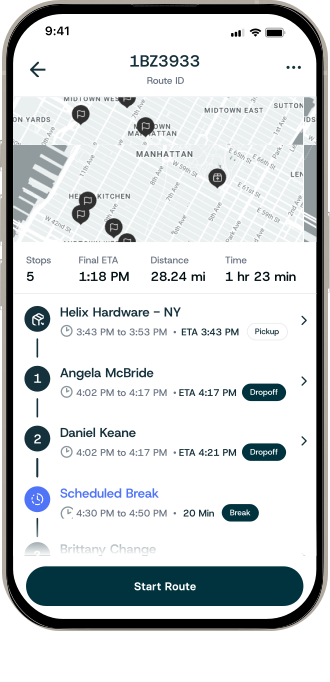
Drivers, vehicles, shifts, pay rules, the Driver App. They live in the same model as every external provider on the network, scored and dispatched against each other in real time. When your fleet has capacity, Nash sends it the work. When it doesn't, the network fills the gap. Owned fleet stops being a fixed cost. It's capacity the platform knows when to use and when to hold.
| Name | Phone | Vehicle | Driver group | Availability | Status | ||
|---|---|---|---|---|---|---|---|
| James Rodriguez | +1 (555) 234-5678 | james.r@example.com | Ford Transit | DowntownRush hour | Available | Enabled | |
| Maria Chen | +1 (555) 345-6789 | maria.c@example.com | Mercedes Sprinter | AirportSuburbs | On shift | Enabled | |
| David Thompson | +1 (555) 456-7890 | — | Nissan NV | Downtown | Unavailable | Disabled | |
| Sarah Kim | +1 (555) 567-8901 | sarah.k@example.com | Chevy Express | SuburbsLate night+1 | Available | Enabled | |
| Michael O'Brien | +1 (555) 678-9012 | michael.o@example.com | — | Airport | On shift | Enabled |
And what your drivers see · the Driver App
Financial reconciliation
Encode pricing client by client and region by region, once. Nash applies it to every delivery, so invoicing and driver pay come out the same way every time, ready to export to your billing and payroll systems. Charges, payouts, and margin sit in one place, so you can track P&L by client, lane, or region without stitching reports together.
Inbound
Outbound
Claims close the same way. Nash reconciles each refund against your matrix and the live delivery data, saving 15% to 21% of the approved refund amount through tighter matrix alignment alone, before any reduction in review labor or overhead.
One integration
Nash sits between the enterprises that need delivery and the fleets that run it. One integration connects you to demand across retail, grocery, QSR, pharmacy, and more, matched to the coverage and service you actually offer. No new connector per customer, no separate sales cycle to reach each one.
Capacity that flexes
Surge windows, equipment down, drivers calling out. Most carriers size for the average day and lose margin on the hot ones. Nash runs your own fleet and the open delivery market as one capacity pool, reliability-scored and geo-aware, so the dispatcher has somewhere to send a load before turning it down.
The network effect
More demand in the network means more routes for the fleets that run it. More fleets mean more reliable coverage for the enterprises that need it. Underneath both, every outcome feeds back: provider scores update, promises tighten, and a carrier joining today inherits everything the network has already learned.
Agentic intelligence layer
AI Agents handle the work that scales the slowest: the "where is my order" questions, driver calls from the road, ETA fixes, POD checks, carrier scoring, and refund reviews. Each one is read against the live delivery, resolved in real time, and handed to a person the moment it needs judgment. The goal is not to replace the people who run the operation; it is to give every one of them the reach of your best operator.
Picks up driver calls from the road. Updates ETAs, notifies recipients, reshuffles the next stop, escalates when it can't resolve.
Updates provider reliability from real performance data and adjusts the active blend continuously.
Reassigns orders before service slips. Fires before customer service feels it.
Validates proof of delivery against the actual stop. Closes the order or flags the exception.
Reconciles refunds against your policy, not memory. The dispatcher stops issuing them by hand.
Take the tour
The frame below is the live portal, running on real orders. Click in. Open it full-screen for the full operator view.
Onboarding
Plugs into your TMS, dispatch and telematics, WMS, and carrier contracts. Single market, lane, or fleet live in weeks. Forward‑deployed engineers sit with your team during onboarding.
Link to your TMS, dispatch and telematics, WMS, and carrier contracts. Snap into the systems you already run.
Score every order against every modality, every minute. Live across your fleet, 3PLs, gig partners, two-person crews, and contracted carriers.
Every dispatch teaches the system. The metric you live by trends in the right direction, week after week.
Carriers run their full operation on Nash, from order intake to driver payout, across their own fleet and the open market. The platform already moves millions of deliveries a month, including third-party delivery inside some of the largest retail networks in the world.
Talk to NashDelivery success
Cost reduction
NPS gain
Deliveries