Insights
Insights
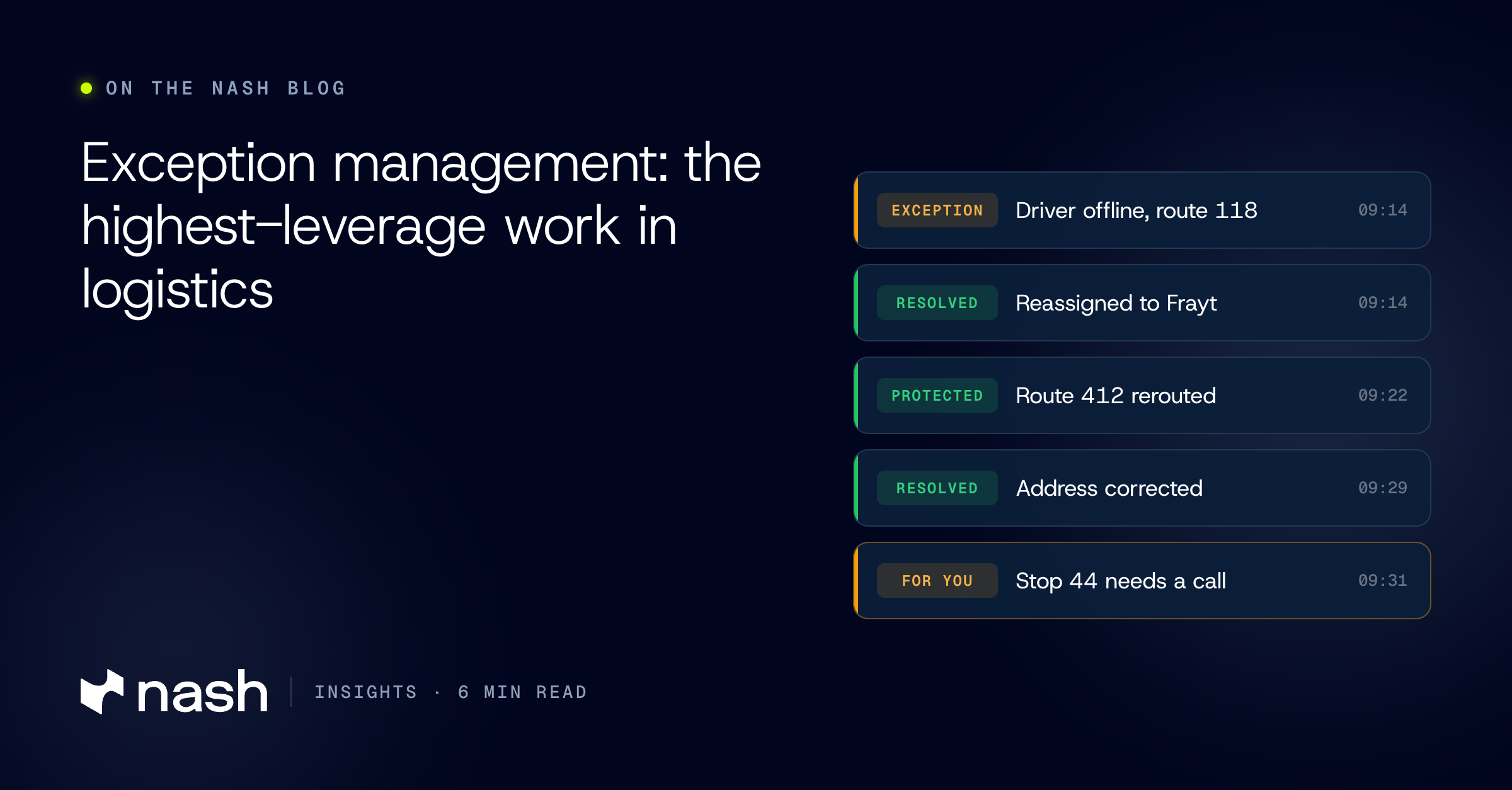
Exception management is the practice of catching the routes and deliveries that break from plan and resolving them before they cost the operation, rather than watching every job with equal weight. It is the highest-leverage work on a dispatch floor, because the cost in a fleet is not spread evenly across a thousand routes. It concentrates in the handful that go wrong. Most logistics software spends its effort re-optimizing the routes that were never in trouble. The shift that moves the number is managing by exception: let the routine run, and put a dispatcher's attention only on the jobs that need it. Nash operations cut manual intervention by 96% doing exactly that.
For twenty years the industry's answer has been more optimization: better routing engines, real-time re-sequencing, a solver that re-runs the plan continuously. The math got very good. The operations did not get much less manual. 73% of supply-chain managers still run on spreadsheets, and 63% use no technology at all to monitor how the operation performs day to day. Planners layer their own judgment on top of the solver's output because they do not fully trust it. The plan is optimal at 8am and wrong by 9:30, when a driver calls out and a customer moves a window. Every dispatch floor has plenty of route math. What it lacks is a way to know which of a thousand routes needs a person right now.
Watch a real fleet and the rhythm is consistent. The master plan gets rebuilt a few times a year, not every day. Between rebuilds, the team runs the operation by absorbing exceptions: a late pickup, a driver who called out, a dock that shut at four. A dispatcher managing a thousand routes needs to find the ten about to break. The real intelligence on the floor is the judgment about where to look, and for decades that judgment has lived in the dispatcher's head because the software never learned to carry it.
The dispatch floor, one shift120 routes · 6 need you
The move is to stop competing on optimization and start managing by exception. On Nash, an autonomic system watches every route continuously, against live context. It resolves the routine on its own, the re-sequences and reassignments that do not need a person. It surfaces the exceptions that do, with the context to act, so a dispatcher spends attention on the calls that carry weight. And it learns from how each one turns out, so the next call is sharper and fewer things reach a person at all. This is already happening. Gartner expects half of supply-chain management solutions to use autonomous agents by 2030, and roughly 15% of daily logistics decisions to be made autonomously by 2028. The dispatch floor is where that shows up first.
It takes real machinery working together. Operational alerting that fires against live conditions, not fixed thresholds, so the signal means something. Automatic failover that recovers a broken route, a driver gone dark or a provider that canceled, before the SLA is at risk, without waiting for a dispatcher to notice. And an exception queue that carries context, not just a red flag, so whoever gets pulled in decides in seconds instead of investigating for ten minutes. Nash runs dispatch autonomously by default and reaches for a person only at the exceptions, which is what human-in-the-loop was always supposed to mean.
Two ways to run a dispatch floor
| A better solver | Managing by exception | |
|---|---|---|
| What it optimizes | The whole plan, re-run continuously | Only the routes that broke from plan |
| What the human does | Reviews and overrides output they don't fully trust | Decides the few exceptions the system escalates |
| How it scales | More routes, more dispatchers | More routes, the same team |
| Where attention goes | Spread across every order | Concentrated where the cost is |
When attention follows the exceptions instead of the whole board, the operation stops needing people to hold it together. Nash customers cut manual intervention by 96% and improve on-time delivery by 93%, because the routine runs itself and the few jobs that need judgment are the only ones a dispatcher sees. The floor scales without adding headcount: more routes, the same team, because the software absorbs the volume and hands up only the exceptions. That capacity story is why 55% of supply-chain leaders already expect agentic AI to change how they staff. The dispatcher's day stops being a thousand small checks and becomes the ten decisions that move the outcome.
Optimization in logistics got very good. Attention, the judgment about where to look, is the part that got left behind. The fleets that run well put judgment where it counts and let the rest run. That is what an autonomic system does: it holds the routine at equilibrium and summons a human at the right moment. Run your operation on Nash, and the thousand routes take care of themselves while your team handles the ten that matter.
What is exception management in logistics?
The practice of catching the routes and deliveries that break from plan and resolving them before they cost the operation, instead of watching every order equally. The cost concentrates in the fraction that break, so exception management puts attention there.
How is it different from route optimization?
Optimization computes a better plan. Exception management runs the operation after the plan meets reality, detecting and resolving the breaks rather than re-solving routes that were never in trouble.
Can dispatch exceptions be resolved automatically?
Yes. An autonomic system resolves the routine cases on its own (reassignments, re-sequences, failover) and escalates only the exceptions that need judgment. Nash cuts manual intervention by 96% this way.
What is the difference between operational alerting and automatic failover?
Alerting is the signal that something needs attention. Failover is the resolution: the system moves a broken order to the next best option before the promise is at risk, without waiting for a person.