Announcements
Announcements
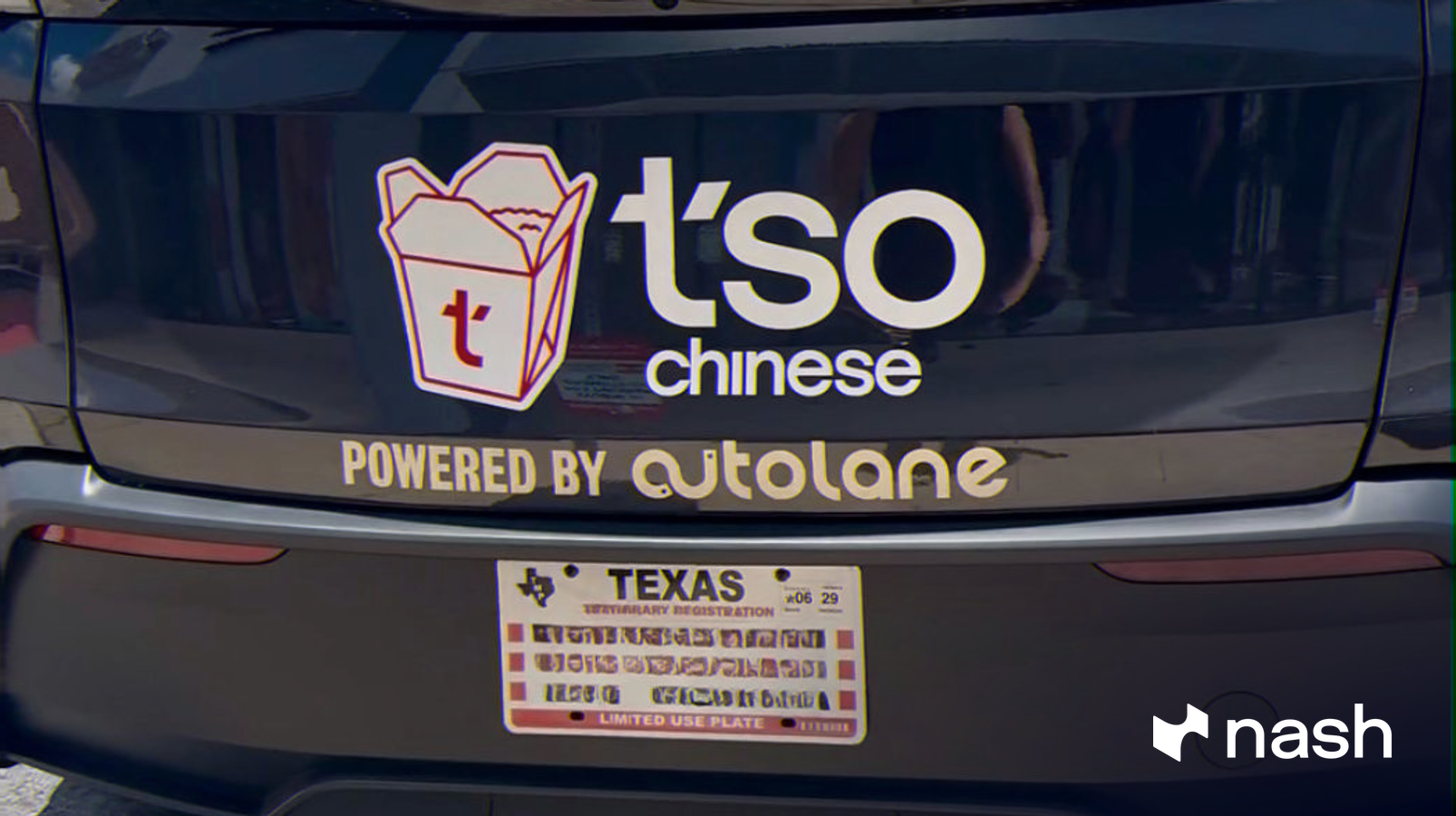
We announced a new partnership with Tso Chinese Takeout & Delivery and Autolane to bring autonomous delivery to Austin.
The service is live at Tso Chinese's Cherrywood location, where select orders are delivered using Autolane's supervised autonomous vehicles. It's expected to expand to Tso Chinese's four other Austin-area locations, with more restaurant and retail launches planned later this year.
Three teams, one goal: local delivery that holds up under real conditions and adapts as they change. Tso Chinese built its business around direct delivery and a strong customer experience. Autolane provides autonomous vehicles and curbside infrastructure. Nash connects that capacity to the rest of the delivery operation, deciding when autonomous delivery is the right fit and managing each order from dispatch through handoff.
Delivery networks are moving toward a mixed-capacity model. Businesses increasingly rely on owned fleets, third-party carriers, gig couriers, store employees, specialized providers, autonomous vehicles, drones, and sidewalk robots. Each option has different strengths, costs, service areas, and operating requirements. The challenge is deciding when each type of capacity makes sense.
An autonomous vehicle may be a strong fit for a short, predictable route with a short, contained handoff. A human courier may be better suited to a complex building, a time-sensitive delivery, or an order that requires direct customer interaction. The right choice can also change throughout the day as traffic, demand, availability, and cost shift.
This is why the next phase of delivery depends on orchestration. Businesses need to understand what each provider can do, what the customer expects, and what's happening across the network in real time, then make that call at the order level and adapt as conditions change, sometimes by the hour or minute. At Nash, we call that autonomic logistics. As new forms of capacity enter the market, the advantage goes to whoever uses each one where it performs best.
Autonomous delivery has moved from a concept to a real source of fulfillment capacity. It still accounts for less than 1% of global food delivery orders, but the economics are starting to shift. Barclays estimates that autonomous deliveries currently cost about $5 to $7 per order in early-adoption markets, compared with roughly $9 to $10 for traditional human delivery.
Broader adoption takes more than putting vehicles on the road. Every delivery still begins with a customer promise: arrive within the expected window, at the right location, in the right condition. The merchant needs visibility into its progress. The customer needs clear communication. The operation needs a plan for when demand shifts, a vehicle goes unavailable, or an order requires a different type of service, and those requirements only grow as autonomous delivery expands.
Vehicles need to connect with the systems responsible for dispatch, tracking, customer updates, exception handling, and performance, and they need to work alongside human couriers and every other source of capacity. Strong autonomous delivery programs evaluate each order on distance, timing, availability, cost, and service requirements, and hold a consistent customer experience as the delivery method changes behind the scenes. That's what turns autonomous delivery into logistics infrastructure a business can actually run on.
When an eligible Tso Chinese order is matched with an Autolane vehicle, the customer gets a text offering autonomous delivery. Once they opt in, Tso Chinese prepares the food and an Autolane supervisor loads the order into the vehicle. Nash manages delivery updates as the order travels to the customer. When the vehicle arrives, the customer taps a link to open the trunk, retrieves the order, and confirms pickup, through the same checkout they already use, with no new app to download and no separate account to create.
Nash evaluates each delivery against the merchant's operating goals, weighing provider performance, service level, cost, reliability, and speed, then dispatches each order against the business's rules and priorities.
Delivery operations absorb change, recover when a plan breaks, and keep working toward better outcomes. Vehicles run late. Drivers call out. Order volume spikes. A delivery that looks straightforward at checkout may need a different call by the time it leaves the store. Nash's AI Agents use shared context across orders, providers, fleets, customer expectations, and live conditions to determine what should happen next, connecting decisioning and execution across the network so operators can select capacity, manage deliveries, address exceptions, and improve performance.
As new forms of capacity come online, the network gets more capable and more complex at the same time. Autonomous vehicles fit naturally into this model: another resource Nash can activate when the order and the operating conditions align.
This launch is the first collaboration between Nash and Autolane, and we're glad to bring it to life with Tso Chinese. Local delivery will keep drawing on a wider mix of vehicles, providers, and automation, and the advantage will come from how well businesses coordinate that capacity. Nash gives merchants one system to apply their operating logic, manage execution, and adapt as the network changes.
Autolane wrote up the launch from their side in The Autonomous Commerce Brief, Issue #019, and the launch has picked up coverage from Automotive World, Retail Technology Innovation Hub, and Trend Hunter. Autonomous vehicles are now making real deliveries for Tso Chinese customers in Austin. We're glad to work with Tso Chinese and Autolane, and we're looking forward to bringing this model to more businesses and markets.