Product Releases
The Autonomic Era of Logistics: What We’re Building at Nash


 6 Min Read
Product Releases
6 Min Read
Every logistics operation has a person like this.
The one who was there when the carrier contract got negotiated, who remembers why that zone has a different SLA, who can look at a morning’s dispatch and tell you by 7 a.m. which parts of the plan aren’t going to hold. When something breaks, they fix it, then quietly update the rule so it doesn’t happen again. When the company wants to do something new, the answer almost always starts with asking them.
The constraint is straightforward: you can only move as fast as that person can be in the room. Most companies have one of them per region. And a long, growing list of things they’d do if only they could be in four places at once. Or forty.
This is the problem we set out to resolve. Today, we’re introducing what that solution looks like. Learn more at nash.ai/agent.
Logistics has always been a manual, expert-dependent process. The plan gets made at 6 a.m. A senior dispatcher spends the day holding it together. A route slips, a provider goes dark, a zone softens. Then somewhere, a person has to catch it, reason through it, and fix it before the customer notices. The institutional knowledge that makes an operation run lives in people’s heads and in manual decisions. When those people aren’t in the room, the operation waits. And loses money.
AI made real progress on this. The first wave of agentic work, refund handlers, WISMO bots, narrow dispatch triggers, replaced specific tasks humans used to do and saved real time and real cost. We’ve shipped about two dozen of these agents inside Nash over the past eighteen months, and they work. We’re proud of them.
But we kept asking a bigger question. What if the goal wasn’t to automate individual tasks, but to build a system that actually runs the operation? One that doesn’t just execute decisions, but gets better at making them, continuously, in production, against real outcomes? One that could hold a thousand zip codes, six fleet types, reliability and cost shifting per zone per shift per provider, and still find the insight a human team would miss? Three insights per city, across a thousand cities, is three thousand decisions a week. No human team can hold that. But a system designed around that problem from the ground up can.
That’s the question we’ve been building toward. And this is our answer.
AI Agents act with the authority of a human operator on the work that used to require one. Route Protection reroutes around SLA risk before the miss happens. Our AI Agents embody the millions of lessons learned across the Nash network, the hard-won best practices we’ve seen work across every operation we run.
Custom Agents go further. They let you encode not just the best practices we see, but the ones only you see, because they’re specific to how your business works. The routines your best operators run in their heads, the ones that have never been written down: you can now stand them up as agents that run indefinitely. Write the trigger, the instructions, and how much autonomy it has. One morning of configuration, and the judgment call your senior operator makes a hundred times a week runs across every account, every region, every shift.
Skills are how your organization defines its work. What counts as a stuck order, when an exception becomes an escalation, what route adherence means here. Custom Agents are how that work gets done without you in the loop. Skills are the vocabulary. Custom Agents are the ones acting on it.
This is operator judgment, encoded once and executed at scale. Decisions get made. But decisions getting made is only half the answer. The other half is what happens to those decisions over time.
Every agentic system can make decisions. That’s table stakes now. But the question we kept asking is: what happens to those decisions over time? Do they compound? Does the system get better at making them? Does it learn, in production, against real outcomes, without a developer pushing deploy?
We think the right word for a system that does all of that is autonomic.
Agentic describes how decisions are made. Autonomic describes how systems operate. Agentic is episodic. Autonomic is continuous. An agentic system acts. An autonomic system acts, learns, improves, and acts better tomorrow than it did today, automatically, against the goal you set, inside the rules you define. The result is a system with four properties: self-configuring, self-healing, self-optimizing, and self-protecting. Every day, against your operation.
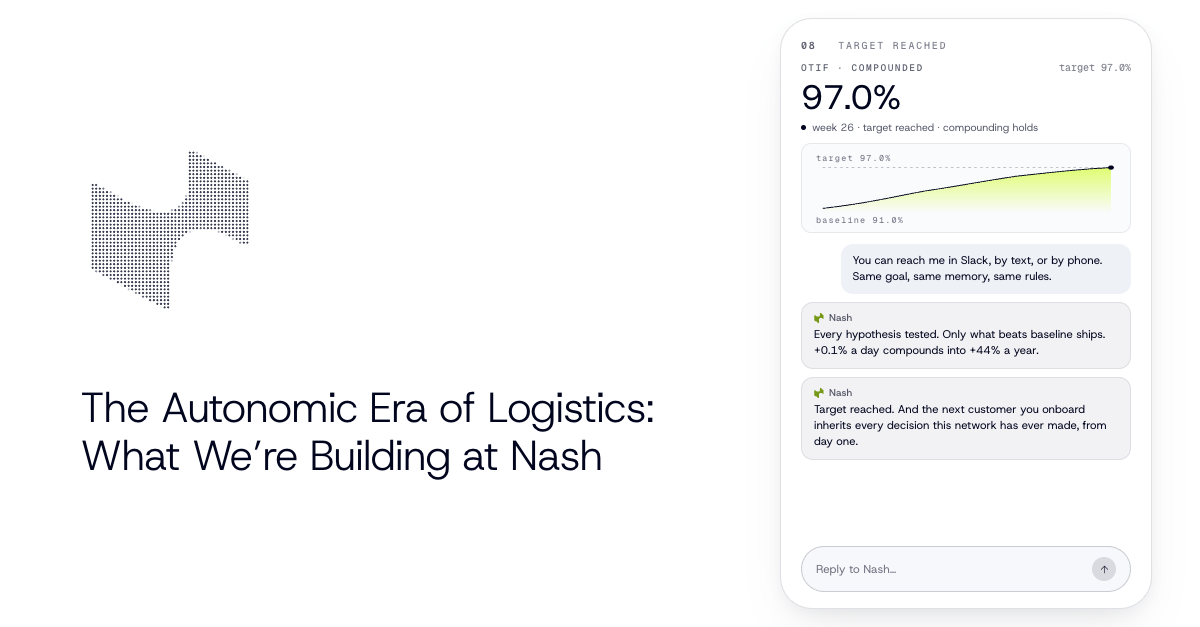
Auto-Improvement runs continuous experiments against the KPI you give it, promotes what beats the baseline, and rolls back what doesn’t. In practice: you give Nash a goal. A real operational objective. Lift OTIF on scheduled fulfillment from 91% to 97% by end of Q4. Hit 99% on-time on your hundred highest-value routes. From there, the system runs continuously: hypothesizing what could move the number, testing it inside your rules, promoting what beats the baseline, rolling back what doesn’t. The math people don’t believe until they’ve lived it: a tenth of a percent improvement per day, sustained, compounds into 44% over a year.
The network remembers. Every job the system touches becomes a lesson the next decision begins with. Intelligence, compounded.
Agentic decisions, compounded by a continuous loop against an objective, become autonomic. That’s what we’ve built. And that’s the era of Nash we’re entering.
We believe the word “agentic” does not fully capture the future direction of continuous improvement, and that “autonomic” really defines the properties we strive for. We know it’s obscure. We think it will be a lot less obscure very soon.
It comes from biology. The autonomic nervous system is the part of your body that regulates heart rate, breathing, and temperature without you having to think about it. It holds you at homeostasis so your conscious mind is free to focus on the things that actually need its attention.
IBM borrowed that idea for software in 2001. The argument being that computing systems were getting too complex for humans to administer, and the only way forward was to give software the same property: it had to run itself. A grand challenge, not a product. The substrate to make it real didn’t exist yet.
We think it does now. And we think logistics is exactly the domain where it proves out first, because logistics has no static optimum. Routes change, providers exit, weather happens, demand shifts. The system can never decide once and then hold. Equilibrium has to be found, and then continuously refound. That’s what autonomic means.
And that’s genuinely what excites us about this moment: for the first time, a logistics operation can pursue that kind of continuous self-improvement without heroic human effort propping it up.
Today, Nash enters private beta on these autonomic capabilities. A first wave of pilot customers has been running on them for the past several weeks in production, against real volume: grocery, restaurant, pharmacy, retail, healthcare, and platforms embedding logistics into their own products. Every component we’re introducing today has run against real load in at least one of those deployments.
If you’re on Nash and want in, ask your account team to add you to the private beta. If you’re not yet a customer and any of this resonates, the fastest way to see it working against your actual operation is a 45-minute conversation with our team. Everything’s at nash.ai.
Read more about our vision at nash.ai/vision.
This is a new era for Nash. An autonomic one. We’re glad you’re here for it.